Complete Guide to Roller Bearing Types in Rolling Mills: From 4-High to 20-High Configurations
Roller bearings are critical core components in modern rolling mills, supporting rotating rolls and maintaining their correct position within the mill housing. Due to the heavy and variable working loads in rolling mills, these bearings must possess low friction coefficients, sufficient strength and rigidity, and facilitate easy roll changes . Different types of rolling mills impose distinct requirements on roller bearings—from 4-high mills to 20-high Sendzimir mills, each configuration demands unique bearing solutions .
Part One: Roller Bearings for 4-High and 6-High Mills
1.1 Four-Row Cylindrical Roller Bearings
In 4-high and 6-high cold rolling mills, four-row cylindrical roller bearings are the most common backup roll bearing type . Their main characteristics include:
High radial load capacity: Capable of withstanding enormous rolling forces, ideal for heavy-duty conditions
High limiting speed: Suitable for high-speed rolling production lines
High manufacturing precision: Typically manufactured to P5 grade or higher
Easy installation and removal: Inner rings interference-fitted on roll necks, outer rings transition-fitted in housings
Application scenarios: Primarily used for backup rolls in high-speed, high-precision mills, such as 1150, 1450, and 1700 specifications for continuous cold rolling mills and temper mills. It should be noted that four-row cylindrical roller bearings cannot accommodate axial loads, requiring separate thrust bearings .
1.2 Four-Row Tapered Roller Bearings
Four-row tapered roller bearings are ideal choices for work rolls in 4-high hot rolling mills and cold rolling mills . Their core advantages include:
Simultaneous radial and axial load capacity: Eliminates the need for additional thrust bearings, enabling more compact mill designs
Convenient installation and removal: Inner rings designed with loose fits on roll necks for rapid roll changes
Low friction coefficient: Superior axial load capacity compared to cylindrical roller bearings
Application scenarios: Widely used in work roll positions for 4-high hot rolling mills, cold rolling mills, as well as blooming mills, beam mills, and other rolling applications. Typical models include 313403C, with outer diameters exceeding 1000mm .
1.3 Other Roller Bearing Types
In 4-high and 6-high mills, additional roller bearing types may be selected based on specific operating conditions:
Spherical roller bearings: Accommodate radial and combined axial loads, compensate for shaft misalignment, suitable for gearboxes and continuous casting rolls
Double-row tapered roller bearings: TDO, TDI types for specific applications
Part Two: Roller Bearings for 8-High and 12-High Mills
8-high and 12-high mills belong to the multi-roll mill family, with roller bearing types positioned between 4-high and 20-high configurations.
2.1 Special Requirements for Backing Bearings
The backup rolls (backing rolls) in 8-high and 12-high mills typically employ high-precision cylindrical roller bearings with the following characteristics:
Thick-walled outer ring design: Bearings function directly as support rolls, with outer ring wall thickness exceeding standard bearings
Ultra-high precision requirements: Accuracy grades typically reaching P5~P4 level
Matched assembly requirements: Multiple bearings installed on a single shaft require outer ring runout and wall thickness dimensional differences controlled within extremely tight tolerances
2.2 Composite Backing Bearings
In recent years, 8-high mills have begun adopting composite backing bearings—these bearings accommodate radial forces while also handling certain axial loads, offering dual functionality. For example, composite backing bearings developed jointly with Beijing MCC for 8-high mills achieve P4 precision grade and have been successfully implemented in multiple steel plants .
Part Three: Roller Bearings for 20-High Sendzimir Mills
20-high Sendzimir mills (Z-Mills) represent the most demanding precision requirements, with the most specialized roller bearing types.
3.1 Characteristics of Sendzimir Mill Bearings
Sendzimir mills employ a 1-2-3-4 roll arrangement with eight backing bearing assemblies, designated A through H . These bearings feature:
Carburized backing bearings: Special heat treatment processes achieve extremely high surface hardness
Micron-level precision: Cross-sectional height grouped in micron increments, with adjacent groups maintaining differences within 3μm
Repairability: Worn outer rings can be reground and reused, significantly reducing operating costs
3.2 Double-Row and Triple-Row Cylindrical Roller Bearings
Common roller bearing types used in 20-high mills include:

These bearings are widely used on Sendzimir mills at major domestic steel plants including Taiyuan Iron and Steel, Ansteel, and Wuhan Iron and Steel .
Part Four: Installation and Maintenance of Rolling Mill Roller Bearings
4.1 Installation Essentials
Correct installation is critical for roller bearing service life:
Pre-installation preparation: Inspect dimensional accuracy and surface roughness of roll necks, bearing housings, and other components
Inner ring heating installation: Four-row cylindrical roller bearing inner rings must be heated to 90~100°C; open flame heating is strictly prohibited
Marking alignment: During installation, pay attention to markings on outer rings and cage-roller assemblies, maintaining initial configuration status
4.2 Failure Prevention
Common failure modes for rolling mill roller bearings include:
Contact fatigue failure: Manifests as fatigue spalling, requiring regular inspection
Wear failure: Includes abrasive wear and adhesive wear, closely related to lubrication conditions
Fracture failure: Typically overload fracture, requiring avoidance of sudden failures
4.3 Service Life Extension Measures
Regular load zone adjustment: Rotate bearing outer rings 120°~180° every 600~800 operating hours to balance wear
Clearance optimization: Excessive or insufficient clearance can lead to premature bearing failure
Lubrication method selection: High-speed mills recommend oil-air lubrication for superior lubrication efficiency, environmental benefits, and lower operating costs
Part Five: Selection Guidelines and BOYA Solutions
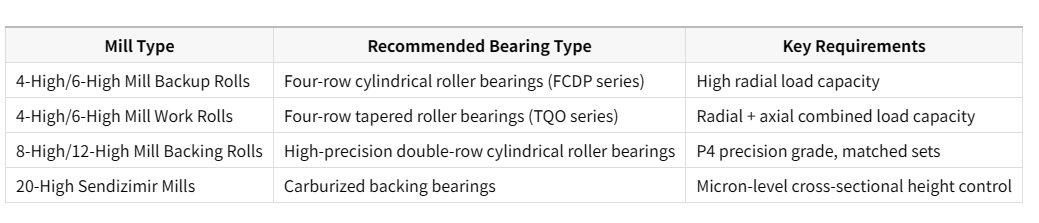
5.1 Roller Bearing Types by Mill Configuration
5.2 BOYA Service Advantages
Beyond individual bearing solutions, boya equipment is designed with a deep understanding of complete rolling mill operations. Our expertise extends to coil preparation lines, where precision roller bearings play a critical role in equipment such as side trimmers, tension levelers, and flatteners. Whether you are optimizing an existing coil preparation line or designing a new finishing facility, BOYA provides bearing solutions that ensure reliable performance, reduced maintenance, and superior strip quality throughout your entire production process.
BOYA's accumulated precision machining experience in the metallurgical equipment field extends to roller bearing types selection and service:
Precision matching: Bearing sets selected and matched in 2μm increments
Installation guidance: Professional installation marking alignment solutions
Repair services: Outer ring grinding, component replacement, and reassembly for bearings reaching service intervals
Lifecycle support: Professional technical support from selection to maintenance
From 4-high mills to 20-high Sendizimir mills, different roller bearing types play unique and essential roles in cold rolling production lines. Correctly understanding and selecting bearings appropriate for your specific mill type not only enhances rolling precision but also significantly reduces operating and maintenance costs. With years of experience in metallurgical equipment manufacturing, BOYA provides professional roller bearing selection consultation and technical support.
For expert assistance in selecting optimal roller bearings for your rolling mill application, contact our technical team today.
Popular BOYA Flat Metal Processing Machinery
Other Articles about BOYA Flat Metal Processing Machinery

 English