 English
 русский
Search
A side trimmer improves metal strip edge quality by removing irregular edge material and cutting both sides of the strip to a controlled final width. When the knife position and cutting clearance are correctly matched to the material, the process reduces excessive burrs, edge tearing, width variation, and unstable edge profiles.
For steel coil, stainless steel strip, and aluminum strip processing, this is particularly important before rewinding. A cleaner and more consistent strip edge helps produce a better finished coil and reduces quality problems in subsequent processing.
A side trimmer uses rotary disc knives positioned on both sides of the moving strip. Instead of simply removing excess width, a well-controlled trimming process creates a repeatable sheared edge along the full coil length.
This improves three areas at the same time:
Edge consistency. Irregular or damaged incoming edges are removed rather than carried into the finished coil.
Width accuracy. Both trimming heads establish the required finished strip width and help limit width variation along the coil.
Cut quality. Correct cutting conditions produce a controlled penetration and fracture zone with limited burr formation. Excessive knife clearance, by comparison, can increase tearing, rollover, and burrs.
For high-speed rewinding lines, maintaining these conditions continuously is more important than achieving a good cut only during initial setup.
Burr formation is closely related to the relationship between the knife and the material.
If the horizontal knife clearance is too large, the strip tends to tear before the fracture zones meet cleanly. This can produce a larger burr and more edge deformation. If the cutting setup is unsuitable in the opposite direction, cutting force and knife wear can also increase.
Material properties matter as well. Carbon steel, stainless steel, and aluminum do not respond identically during shearing. Strip thickness, strength, hardness, and operating speed therefore need to be considered when setting the trimming parameters.
Knife condition is another factor. As disc knives wear, cutting quality can gradually deteriorate and burr formation can increase. Industrial edge-monitoring systems consequently use burr and cut-surface condition as indicators of trimming performance and knife wear.
Knife clearance is one of the most influential settings in rotary side trimming.
The objective is not to force the knives through the entire strip thickness. Proper rotary shearing allows part of the material to be penetrated by the knife before a controlled fracture completes the separation.
For this reason, the optimum clearance must be matched to the strip rather than treated as one fixed setting for every coil.
Vertical overlap also affects cutting conditions, although its influence is different from horizontal clearance. Excessive overlap can increase sliding friction, heat generation, and knife wear.
For processors working with changing coil specifications, accurate and repeatable knife adjustment is therefore essential to consistent edge quality.
Edge trimming directly influences the quality of the finished rewound coil.
When strip width remains consistent and both edges follow a stable line, the rewinding process can maintain better coil geometry. Irregular edges, local width changes, or attached trim defects can make edge alignment more difficult and reduce the visual and dimensional quality of the finished coil.
This is especially relevant for stainless steel strip, coated steel, precision cold-rolled strip, and aluminum strip where customers may have tighter requirements for finished coil appearance and dimensional consistency.
A side trimmer should therefore be considered part of the overall rewinding quality-control process rather than an isolated cutting machine.
For production lines processing multiple strip specifications, cutting accuracy alone is not enough. Buyers should also evaluate whether the machine can maintain stable knife positioning, support practical parameter adjustment, manage knife wear, and operate reliably at the required line speed.
Maintenance design also matters because knife replacement, cleaning, and adjustment directly affect production availability.
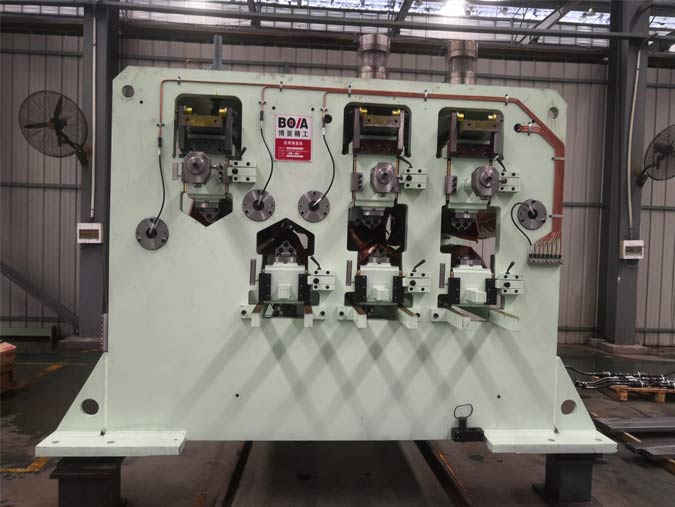
BOYA's Side Trimmer for Rewinding Line uses disc-knife positioning and hydraulic locking, together with a cutter cleaning device and scraper mechanism. Deburring rollers and edge grinding mechanisms are also available as optional configurations when additional edge finishing is required. The current application range covers carbon steel, stainless steel and aluminum alloys, among other flat-strip materials.
These functions are particularly useful where a rewinding line must handle changing strip grades while keeping edge quality stable.
A side trimmer improves steel coil and metal strip quality by controlling finished width and removing defective or irregular strip edges before rewinding. The quality of the result depends heavily on knife clearance, positioning accuracy, knife condition, and parameter control.
For steel, stainless steel, and aluminum strip processors, a properly configured trimming system can reduce burrs and edge irregularities while improving width consistency and finished coil quality.
When selecting equipment, the more useful question is not simply how fast the machine can cut, but whether it can maintain the required edge quality across the actual material range and production conditions.
It trims both longitudinal edges of a moving metal strip to achieve the required width and improve edge consistency.
Yes. Correct knife clearance, accurate positioning, sharp blades, and suitable cutting parameters can significantly control burr formation.
Depending on the machine design, typical materials include carbon steel, stainless steel, aluminum, and other flat metal strips.
Incorrect clearance can cause excessive deformation or tearing instead of a controlled shear fracture, resulting in larger burrs and poorer edges.
Yes. Consistent strip width and cleaner edges support better coil alignment, finished coil geometry, and downstream processing quality.